

Hey there! As a supplier of Titanium Forged Rings, I often get asked this question: "Are Titanium Forged Rings heavy?" Well, let's dive right into it and find out.
First off, let's talk a bit about titanium itself. Titanium is a pretty amazing metal. It's known for its high strength - to - weight ratio. That means it can be as strong as some steels, but it weighs a whole lot less. You see, heavy metals like lead or iron are really dense, and that's what makes them heavy. But titanium isn't like that. It has a density of about 4.5 grams per cubic centimeter. In comparison, steel has a density that can range from 7.75 to 8.05 grams per cubic centimeter. So, right off the bat, we can see that titanium is lighter than steel in terms of density.

Now, when we're talking about Titanium Forged Rings, the weight will depend on a few factors. The size of the ring is a big one. Obviously, a larger ring is going to weigh more than a smaller one. If you think about it, if you have two cubes made of the same material, but one is twice as big as the other in all dimensions, the larger cube will weigh eight times more. It's all about volume, and volume is calculated by multiplying length, width, and height.
Another factor is the wall thickness. A ring with a thicker wall will be heavier than one with a thinner wall. For example, if you have two rings of the same outer diameter, but one has a wall that's 10 millimeters thick and the other has a wall that's 5 millimeters thick, the one with the 10 - millimeter wall will weigh more. The thickness adds to the overall volume of the ring, and since titanium has mass, more volume means more weight.
Let's take a look at some common applications of Titanium Forged Rings. In the aerospace industry, weight is a huge deal. Every extra pound on an aircraft means more fuel consumption, which costs more money and is also bad for the environment. That's why titanium is so popular in this field. AMS 4928 Titanium Alloy Forging Ring for Aerospace is a great example of a titanium ring used in aerospace. These rings need to be strong enough to withstand the high stresses of flight, but they also need to be as light as possible. And titanium fits the bill perfectly.
In the automotive industry, weight reduction is also a key goal. Lighter parts can improve the performance of a vehicle, making it more fuel - efficient and faster. Titanium Forged Rings can be used in engines, transmissions, and other critical components. They offer the strength needed for these applications without adding excessive weight.
Back to the weight question. If you're comparing a Titanium Forged Ring to a ring made of a heavier metal like brass or a high - carbon steel, the titanium ring will be significantly lighter. But if you compare it to a ring made of a very light material like aluminum, the titanium ring might be a bit heavier. However, titanium has much better strength and corrosion resistance than aluminum, so it's often the preferred choice in many applications.
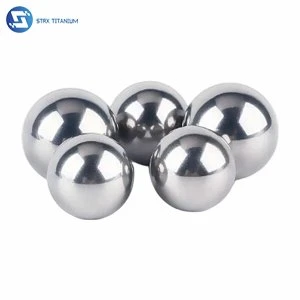
Now, let's touch on some of the other products we offer. We also have Seamless Rolled Titanium Ring Titanium Forged Ring. These seamless rings are made through a special rolling process, which gives them a uniform structure and excellent mechanical properties. And if you're looking for something a bit different, we have Polished Titanium Ball. These balls are not only smooth and shiny but also have the same great characteristics of titanium, like high strength and corrosion resistance.
So, to answer the question "Are Titanium Forged Rings heavy?" It depends on what you're comparing them to. Compared to many common metals, they're relatively light. But their weight can vary based on size and wall thickness.
If you're in the market for Titanium Forged Rings or any of our other titanium products, we'd love to talk to you. Whether you're in the aerospace, automotive, or any other industry that can benefit from titanium's unique properties, we can provide you with high - quality products. Reach out to us to discuss your specific requirements and let's see how we can work together.
References:
- "Materials Science and Engineering: An Introduction" by William D. Callister Jr. and David G. Rethwisch.
- Industry reports on aerospace and automotive materials.