

As a supplier of titanium fasteners, I've witnessed firsthand the growing demand for these high - performance components across various industries. Titanium fasteners are favored for their exceptional strength - to - weight ratio, corrosion resistance, and biocompatibility. But what exactly are the standards that govern these remarkable products? In this blog, I'll delve into the key standards for titanium fasteners, providing insights that can help you make informed decisions when sourcing these essential parts.
ASTM Standards
The American Society for Testing and Materials (ASTM) plays a pivotal role in setting the standards for titanium fasteners. ASTM has developed a series of specifications that cover different aspects of titanium fasteners, from material composition to mechanical properties.
ASTM B348
This standard focuses on the chemical composition and mechanical properties of titanium and titanium alloy bars and billets. Since many titanium fasteners are manufactured from bars, ASTM B348 serves as a fundamental reference. It classifies titanium into different grades, such as Grade 2 (commercially pure titanium) and Grade 5 (Ti - 6Al - 4V, a widely used titanium alloy). Each grade has specific chemical requirements and mechanical property ranges. For example, Grade 2 titanium has a minimum yield strength of 170 MPa and a minimum ultimate tensile strength of 240 MPa, making it suitable for applications where moderate strength and excellent corrosion resistance are needed.
ASTM F467 and ASTM F468
ASTM F467 deals with the standard specification for titanium and titanium alloy nuts, while ASTM F468 covers bolts, screws, studs, and other externally threaded fasteners. These standards define the dimensional requirements, mechanical properties, and quality control procedures for titanium fasteners. They ensure that the fasteners have the correct thread pitch, diameter, and length, and that they can withstand the intended loads. For instance, the standards specify the minimum proof load and tensile strength for different sizes and grades of fasteners.
ISO Standards
The International Organization for Standardization (ISO) also contributes to the standardization of titanium fasteners. ISO standards are recognized globally and are often used in international trade and manufacturing.
ISO 5855
This standard provides the general requirements for aerospace - quality titanium alloy bolts and nuts. It covers aspects such as material, dimensions, mechanical properties, and surface finish. In the aerospace industry, where safety and reliability are of utmost importance, ISO 5855 ensures that titanium fasteners meet the stringent requirements of aircraft design and operation. The standard specifies the allowable tolerances for dimensions, which are crucial for proper fit and function in aerospace applications.
ISO 16232
ISO 16232 focuses on the cleanliness of parts used in the automotive and other industries. Although not specific to titanium fasteners, it is relevant as it addresses the issue of particle contamination. Titanium fasteners need to be clean to prevent damage to mating parts and to ensure proper performance. This standard provides methods for measuring and controlling the level of contamination on fasteners.
Industry - Specific Standards
In addition to the general ASTM and ISO standards, there are also industry - specific standards for titanium fasteners.
Aerospace Industry
The aerospace industry has its own set of strict standards for titanium fasteners. For example, the National Aerospace Standards (NAS) in the United States and the European Aerospace and Defence Industries Association (ASD) standards in Europe define the requirements for aerospace fasteners. These standards take into account the extreme conditions that aerospace fasteners must endure, such as high - altitude flight, temperature variations, and vibration. Titanium fasteners used in aerospace applications must be able to maintain their integrity under these harsh conditions.
Medical Industry
In the medical field, titanium fasteners are widely used due to their biocompatibility. Standards such as the ASTM F136 for surgical implant applications ensure that titanium fasteners used in medical devices are safe and effective. The standard specifies the chemical composition, mechanical properties, and surface characteristics of titanium alloys used for medical implants. For example, it requires that the titanium alloy used in implants has a low level of impurities to minimize the risk of adverse reactions in the human body.
Our Product Offerings and Compliance
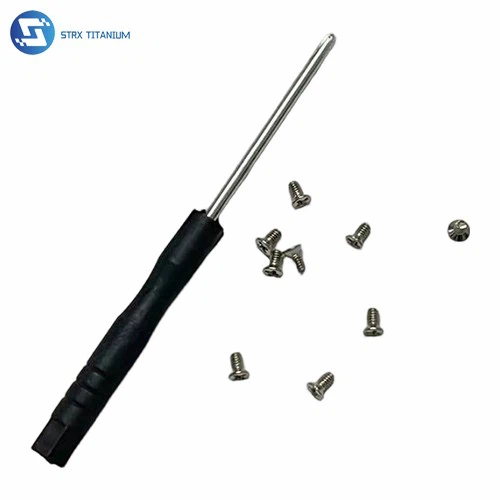
As a supplier of titanium fasteners, we are committed to meeting and exceeding these standards. We offer a wide range of titanium fasteners, including Titanium Bolts, Titanium Threaded Rod, and Titanium Micro Mini Bolts Kits.
Our manufacturing process is carefully monitored to ensure that all our products comply with the relevant ASTM, ISO, and industry - specific standards. We source high - quality titanium materials from reputable suppliers and conduct rigorous quality control tests at every stage of production. Our in - house testing facilities are equipped with advanced equipment to measure the mechanical properties, chemical composition, and dimensional accuracy of our fasteners.
Why Choose Our Titanium Fasteners
When you choose our titanium fasteners, you can be confident in the quality and performance of the products. Our fasteners are not only compliant with the highest standards but also offer several advantages:
High - Quality Materials
We use only the best titanium materials, ensuring that our fasteners have excellent strength, corrosion resistance, and durability. Whether you need fasteners for a marine environment, an aerospace application, or a medical device, our products can meet your requirements.
Customization Options
We understand that different customers may have unique needs. That's why we offer customization services for our titanium fasteners. We can manufacture fasteners in different sizes, shapes, and grades according to your specifications.
Competitive Pricing
Despite the high quality of our products, we offer competitive pricing. We have optimized our production process to reduce costs without compromising on quality. This allows us to provide you with cost - effective titanium fasteners.
Contact Us for Your Titanium Fastener Needs
If you are in the market for high - quality titanium fasteners, we invite you to contact us. Our experienced sales team can provide you with detailed product information, answer your questions, and assist you in finding the right fasteners for your application. Whether you need a small quantity for a prototype or a large order for a production project, we can meet your demand.

Don't hesitate to reach out to us for a quote or to discuss your specific requirements. We look forward to partnering with you and providing you with the best titanium fasteners on the market.
References
- ASTM International. (n.d.). ASTM standards for titanium and titanium alloys. Retrieved from the ASTM official website.
- International Organization for Standardization. (n.d.). ISO standards related to fasteners. Retrieved from the ISO official website.
- Aerospace Industries Association. (n.d.). Aerospace standards for fasteners. Retrieved from the AIA official website.
- Medical Device Manufacturers Association. (n.d.). Standards for medical titanium fasteners. Retrieved from the MDMA official website.