From The World’s Factory To Advanced Manufacturing: How Chinese Titanium Cups Are Expanding Into Western Markets

Aug 21, 2026 Leave a message

China's titanium cup industry is moving from OEM manufacturing toward advanced manufacturing, product innovation, and global brand development. Driven by the growth of outdoor recreation, premium hydration, health-conscious consumption, and demand for lightweight reusable drinkware, titanium cups are becoming increasingly visible in North American and European markets.

For buyers looking for lightweight titanium water bottles, titanium camping cups, titanium mugs, titanium tumblers, titanium cookware, and premium reusable drinkware, titanium offers a distinctive combination of low density, corrosion resistance, durability, and a premium material story.

The opportunity is no longer simply about producing a titanium cup at a lower cost.

It is increasingly about material quality, forming technology, surface finishing, food-contact compliance, product design, supply-chain reliability, and global brand capability.
info-400-267

1. A New Growth Wave: Why Titanium Drinkware Is Entering the Mainstream

Titanium drinkware was once primarily associated with outdoor enthusiasts, mountaineers, ultralight backpackers, and specialty equipment users.

Today, that positioning is changing.

The category is gradually expanding toward:

Outdoor recreation

Camping and hiking

Ultralight backpacking

Travel

Business commuting

Premium everyday drinkware

Coffee and tea

Adventure sports

Emergency and survival equipment

High-end lifestyle products

Recent market research estimates illustrate this growth.

One 2026 market study estimates that the global titanium cup market reached approximately US$295.5 million in 2025 and could reach around US$448.75 million by 2032, representing a CAGR of approximately 6.15%. The same study identifies North America as the largest regional market and outdoor recreation and camping as the largest application segment.

Exact market values vary considerably between research companies because market definitions differ. Some studies count titanium cups only, while others include titanium mugs, tumblers, bottles, cookware, and other titanium drinkware.

The broader trend, however, is clear:

Titanium drinkware is moving from a niche outdoor product toward a premium reusable drinkware category.

2. Why Titanium? The Material Story Behind Premium Drinkware

The growing interest in titanium cups is closely related to the material itself.

Titanium is well known for its combination of:

Lightweight construction

Titanium has a density of approximately 4.5 g/cm³, significantly lower than conventional stainless steel.

For outdoor users, every gram matters.

This makes titanium particularly attractive for:

Ultralight backpacking

Long-distance hiking

Bikepacking

Mountaineering

Camping

Travel

Emergency equipment

High corrosion resistance

Titanium naturally forms a stable passive oxide layer that provides excellent corrosion resistance.

This is one reason titanium has long been used in demanding industries such as:

Aerospace

Chemical processing

Marine engineering

Medical devices

Power generation

The same material characteristic creates a compelling value proposition for premium drinkware.

High strength-to-weight ratio

Titanium provides an attractive balance between strength and weight.

For a reusable cup or mug, this can mean a durable product without the weight penalty associated with some conventional materials.

Low risk of metallic taste

Titanium is frequently marketed for drinkware because its stable surface can provide a neutral drinking experience.

This is especially attractive for consumers who are sensitive to metallic taste or want a premium alternative to plastic drinkware.

Long service life

Unlike disposable plastic cups and bottles, high-quality titanium drinkware is designed for repeated use.

That aligns closely with the global trend toward:

Reusable + Durable + Lightweight + Premium

3. The Rise of "Ultralight" Outdoor Consumption

One of the most important drivers of the titanium cup market is the continued growth of ultralight outdoor gear.

For hikers and backpackers, weight is not simply a specification.

It affects the entire experience.

A lighter cup means:

Lower pack weight → easier transportation → greater mobility → better outdoor experience

This has created strong demand for:

Titanium camping cups

Titanium camping mugs

Titanium bowls

Titanium sporks

Titanium cookware

Titanium water bottles

Titanium coffee cups

Titanium folding cups

The opportunity for manufacturers is therefore not limited to one product.

It extends into an entire titanium outdoor cookware and drinkware ecosystem.

4. From OEM Manufacturing to Chinese Advanced Manufacturing

The biggest change in China's titanium cup industry is not simply increased production capacity.

It is the transition from:

OEM → ODM → product innovation → global brand development

Chinese manufacturers increasingly have access to integrated supply chains covering:

Titanium raw materials

Titanium sheet

Titanium strip

Titanium tube

Deep drawing

Spinning

Stamping

Welding

Vacuum insulation

CNC machining

Surface treatment

Anodizing

Laser marking

Packaging

Private labeling

OEM / ODM development

This integrated manufacturing capability can significantly shorten product-development cycles.

For international buyers, the value proposition is therefore changing from:

"China offers competitive prices."

to:

"China can provide material, engineering, manufacturing, customization, and scalable supply-chain solutions in one ecosystem."

That distinction is increasingly important in premium consumer goods.

5. Titanium Deep Drawing: One of the Key Manufacturing Technologies

High-quality titanium cups are not simply "metal cups made from titanium."

Manufacturing technology directly affects:

Wall thickness

Dimensional accuracy

Surface quality

Bottom geometry

Rim consistency

Mechanical strength

Weight

Appearance

Production yield

Titanium deep drawing is therefore an important manufacturing technology for premium titanium drinkware.

Titanium has relatively high strength and low thermal conductivity compared with common cup materials, which creates challenges during forming.

Manufacturers need to carefully control:

Material grade

Sheet thickness

Blank size

Drawing ratio

Tool geometry

Lubrication

Forming speed

Intermediate annealing

Springback

Surface protection

This is where advanced manufacturing capability becomes a competitive advantage.

For B2B buyers, the important question is not simply:

"Can you manufacture titanium cups?"

It is:

"Can you consistently manufacture the same dimensions, wall thickness, weight, surface finish, and forming quality across production batches?"

6. From Simple Titanium Cups to Premium Product Design

Another important market trend is the transition from functional products toward premium titanium lifestyle products.

Modern consumers increasingly care about:

Minimalist design

Ergonomics

Lightweight construction

Premium tactile experience

Color

Branding

Sustainability

Portability

Product storytelling

This is driving innovation in:

Titanium tumblers

Designed for everyday drinking, commuting, coffee, tea, and travel.

Titanium camping mugs

Designed for outdoor recreation and ultralight backpacking.

Double-wall titanium cups

Designed for better thermal performance while maintaining relatively low weight.

Titanium insulated bottles

Targeting premium hydration and outdoor markets.

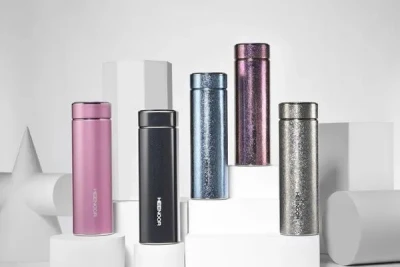
Colored titanium drinkware

Anodized titanium surfaces can create distinctive visual effects without relying on conventional paint systems.

Custom titanium drinkware

Designed for private-label brands, outdoor companies, corporate gifts, and specialty retailers.

This is where OEM titanium cup manufacturing and ODM titanium drinkware development become increasingly important.

7. Titanium Anodizing Is Creating a New Premium Aesthetic

One of the most visually distinctive technologies used in titanium consumer products is titanium anodizing.

Instead of simply painting the surface, controlled anodization can create different interference colors through modification of the oxide layer.

This allows manufacturers to develop:

Blue titanium cups

Purple titanium mugs

Gold titanium tumblers

Rainbow titanium drinkware

Gradient titanium products

Custom-branded titanium accessories

This creates a major opportunity for brands that want to differentiate their products visually.

The result is a combination of:

Engineering material + premium design + customization

That is particularly attractive in the premium outdoor and lifestyle market.

8. Food-Contact Compliance Is Becoming a Competitive Advantage

As titanium drinkware enters mainstream markets, food-contact compliance is becoming just as important as product design.

This is an area where international manufacturers need to be precise.

In the United States, FDA regulates food-contact substances according to their specific use and applicable authorization framework. Food-contact substances may require authorization through applicable regulations or Food Contact Notifications, and safety assessments consider factors including migration and intended conditions of use.

The FDA also distinguishes different food types and conditions of use, including beverages, refrigerated storage, room-temperature storage, hot filling, and other conditions.

Therefore, a manufacturer should avoid simply stating:

"FDA approved titanium cup."

A more professional approach is:

"Food-contact compliance should be evaluated according to the specific material, manufacturing process, coating, intended food type, and conditions of use."

For European markets, food-contact materials are subject to the EU framework under Regulation (EC) No 1935/2004, which requires materials and articles intended to contact food to meet safety requirements and not release constituents at harmful levels or adversely affect food composition, taste, or odor. EU food-contact materials are also subject to applicable Good Manufacturing Practice requirements.

For international B2B buyers, documentation can therefore become a powerful competitive advantage:

Material certificates

Chemical composition

Migration testing where applicable

Food-contact test reports

Coating specifications

Manufacturing traceability

Batch inspection reports

Supplier declarations

Quality-control documentation

The future competition in titanium drinkware will increasingly be about compliance + consistency + traceability, not only price.

9. Sustainability Is Changing the Reusable Drinkware Market

Another major keyword driving consumer demand is:

sustainable drinkware

Consumers increasingly want products that can replace disposable bottles, cups, and food containers.

Titanium fits naturally into this narrative because it is:

Durable

Reusable

Lightweight

Corrosion resistant

Designed for long-term use

However, sophisticated B2B buyers are increasingly asking a more difficult question:

"What is the total environmental impact of the product?"

This means manufacturers will need to think beyond the material itself.

Future competitiveness may depend on:

Product lifetime

Manufacturing efficiency

Scrap recycling

Packaging reduction

Supply-chain distance

Repairability

Product durability

End-of-life recycling

This creates an opportunity for Chinese manufacturers to move from simply promoting "eco-friendly titanium" toward providing measurable sustainability information.

10. North America: The Core Market for Outdoor Titanium Drinkware

North America is particularly attractive because of its strong outdoor recreation culture.

Demand is driven by:

Hiking

Camping

Backpacking

Hunting

Fishing

Overlanding

RV travel

National park tourism

Adventure travel

Emergency preparedness

Market research currently identifies North America as the largest regional market for titanium cups.

For Chinese manufacturers, this creates several B2B opportunities:

Outdoor brands

Camping equipment distributors

Sporting goods retailers

Ultralight backpacking brands

Private-label companies

E-commerce brands

Corporate gifting companies

Outdoor specialty stores

The most attractive buyers are not necessarily looking for the cheapest cup.

They are looking for:

Reliable OEM + consistent quality + flexible MOQ + customization + stable lead time + documentation.

11. Europe: Sustainability, Minimalism and Product Quality

The European market has a somewhat different product story.

European consumers often place strong emphasis on:

Sustainability

Minimalist design

Product longevity

Material transparency

Food-contact safety

Environmental responsibility

Premium craftsmanship

This creates opportunities for minimalist titanium drinkware positioned around:

Lightweight + durable + reusable + premium + traceable

For European B2B buyers, compliance documentation and supply-chain transparency can be particularly important because food-contact materials are regulated within the EU framework.

Therefore, Chinese manufacturers targeting Europe should build their marketing around more than:

"Made in China."

The stronger message is:

"Engineered and manufactured in China with controlled materials, traceable production, international testing, and consistent quality."

12. The Next Opportunity: Smart Titanium Drinkware

The original titanium cup market is also beginning to intersect with the smart drinkware trend.

Consumers increasingly expect products to provide more than basic hydration.

Potential technologies include:

Temperature display

Smart lids

Digital temperature sensors

NFC identification

Product tracking

Hydration reminders

Mobile connectivity

Intelligent thermal management

However, smart functionality should not replace the fundamental value of the product.

The winning formula may be:

Premium titanium + lightweight design + thermal performance + smart functionality

rather than simply adding electronics to a traditional cup.

13. Custom Titanium Cups: A Major B2B Opportunity

One of the strongest opportunities for Chinese manufacturers is custom titanium drinkware.

International brands may require:

Custom logo

Laser engraving

Custom color

Custom capacity

Custom wall thickness

Custom handle

Custom lid

Custom packaging

Custom gift boxes

Private label

OEM production

ODM product development

For example, a brand may want:

300 ml titanium camping mugs for ultralight backpacking

while another buyer may require:

450 ml double-wall titanium tumblers for premium everyday use.

The underlying material may be similar.

The commercial opportunity is completely different.

This is why flexible manufacturing is becoming increasingly valuable.

14. Why China Has a Supply-Chain Advantage

China's competitiveness in titanium drinkware is not based on one factory.

It comes from the combination of:

Titanium raw materials

Metal processing

Precision forming

Surface treatment

Product assembly

Packaging

Global logistics

OEM / ODM

This integrated ecosystem can allow international brands to develop products faster and scale production more efficiently.

For overseas buyers, the strongest Chinese supplier is therefore not necessarily the company offering the lowest quotation.

It is the company that can provide:

Material stability + engineering capability + quality control + customization + production capacity + export experience.

15. What Will Define the Next Generation of Titanium Cup Suppliers?

The next stage of competition will likely be determined by five factors.

1. Material Quality

Consistent titanium grade, chemical composition, thickness, and mechanical properties.

2. Manufacturing Precision

Stable forming, welding, deep drawing, spinning, and dimensional control.

3. Surface Engineering

Reliable polishing, brushing, anodizing, laser marking, and finishing.

4. Compliance and Traceability

Food-contact documentation, test reports, batch traceability, and quality records.

5. Product Innovation

Lightweight design, double-wall insulation, smart features, ergonomic design, and customization.

This represents a major transition:

From "China manufacturing" to "China engineering."

16. The Global Opportunity Toward 2030

The titanium drinkware industry remains relatively small compared with stainless steel and plastic drinkware.

That is exactly what makes it attractive.

A niche market can develop rapidly when several consumer trends converge:

Outdoor recreation


Ultralight backpacking


Premium hydration


Reusable drinkware


Sustainability


Material innovation


E-commerce


Private-label brands


OEM/ODM manufacturing

The current market data already points toward continued growth through 2032, although the exact market size varies depending on how titanium cups and related drinkware are defined.

The larger opportunity is therefore not simply to sell more titanium cups.

It is to build a global titanium consumer-products ecosystem.

From:

Titanium cups

to:

Titanium bottles → titanium mugs → titanium bowls → titanium cookware → titanium utensils → premium outdoor equipment

The potential product portfolio is significantly larger than one category.

Conclusion: Titanium Is Moving From a Material Story to a Global Consumer Brand Story

The global titanium cup industry is entering a new stage.

The first stage was:

Titanium as a premium material.

The second stage is:

Titanium as a high-performance consumer product.

The next stage will be:

Titanium as a global lifestyle brand.

For Chinese manufacturers, this represents a significant opportunity.

China already possesses one of the world's most complete manufacturing ecosystems.

The challenge now is to convert manufacturing capability into:

Better engineering

Better product design

Better compliance

Better quality control

Better international branding

Better customer experience

The companies that succeed in the next five years will not simply compete on manufacturing cost.

They will compete on material technology, advanced forming, food-contact compliance, lightweight design, sustainability, customization, supply-chain reliability, and global brand building.

And that is why the future of Chinese titanium cups is not simply about becoming another low-cost supplier.

It is about becoming a global source of advanced titanium drinkware and premium consumer products.