Titanium Plate Plastic Forming Technology: The Core Manufacturing Process Behind High-End Industries
From aerospace aircraft structures and deep-sea exploration equipment to medical implants and premium consumer products, one advanced metal material continues to play a critical role in modern high-performance manufacturing - titanium and titanium alloys.
Since industrial titanium production began in the mid-20th century, titanium processing technology has undergone more than six decades of continuous innovation. Today, titanium has become an indispensable material for advanced manufacturing industries due to its outstanding combination of:
High specific strength
Excellent corrosion resistance
Superior biocompatibility
These properties make titanium alloys widely used in:
Aerospace components
Aircraft engine structures
Medical implants and surgical devices
Chemical processing equipment
Marine engineering systems
Hydrogen energy equipment
Semiconductor manufacturing
High-end consumer products
Among various titanium products, titanium plates and titanium sheets represent one of the most important forms of titanium material supply.
High-quality titanium plates are not simply produced by rolling metal into shape. They require precise control of alloy composition, temperature, deformation behavior, surface protection, heat treatment, and quality inspection throughout the entire manufacturing process.
1. Understanding the Core Technology: What Is Titanium Plate Plastic Forming?
Titanium plate plastic forming refers to a manufacturing process where external forces are applied to solid titanium materials, causing controlled permanent deformation while improving internal microstructure and mechanical properties.
The purpose is not only to achieve the required dimensions but also to optimize:
Grain structure
Mechanical strength
Fatigue resistance
Surface quality
Material reliability
Compared with conventional metals such as steel, aluminum, and copper, titanium has much higher processing difficulty because of its unique physical and chemical characteristics.
This is why titanium plate manufacturing technology has become a key competitive capability among global titanium suppliers.
Basic Principles of Titanium Plastic Processing
1. Stress-Strain Control
During titanium plate rolling, controlling deformation amount and deformation speed is essential.
Precise control of:
Rolling reduction rate
Strain distribution
Deformation temperature
Rolling speed
helps prevent:
Uneven deformation
Internal cracks
Edge cracking
Microstructure instability
2. Temperature Sensitivity Control
Titanium is highly sensitive to temperature changes.
The processing temperature directly affects:
Phase transformation behavior
Grain growth
Mechanical properties
Final product performance
For example:
Pure titanium has an alpha-to-beta transformation temperature around 882°C, while Ti-6Al-4V (Grade 5 titanium alloy) requires carefully controlled processing near the beta transition temperature.
A small temperature deviation can significantly influence:
Strength
Ductility
Fatigue performance
3. Friction and Lubrication Management
During rolling, friction between titanium plate surfaces and rolling equipment directly affects:
Surface roughness
Flatness
Thickness uniformity
Surface defects
Therefore, advanced titanium manufacturers use optimized lubrication systems and cooling strategies to maintain stable production.
Why Is Titanium Plate Difficult to Process?
Although titanium provides exceptional performance advantages, its processing difficulty creates significant manufacturing barriers.
The four major challenges include:
1. High Deformation Resistance
Titanium has a relatively low elastic modulus, approximately 55% of steel.
However, titanium alloys demonstrate:
High work hardening tendency
Strong deformation resistance
Rapid strength increase during processing
This makes titanium plate rolling much more demanding compared with aluminum or stainless steel.
2. Narrow Processing Temperature Window
Titanium alloys require extremely accurate temperature control.
For example:
Pure titanium processing temperature range: approximately 850-950°C
Ti-6Al-4V alloy processing range: carefully controlled around the alpha-beta phase region
Overheating may cause:
Excessive grain growth
Reduced toughness
Poor fatigue resistance
Underheating may result in:
Cracking
Increased rolling force
Non-uniform microstructure
3. High-Temperature Oxidation Sensitivity
When titanium is heated above approximately 600°C, it easily reacts with oxygen, nitrogen, and hydrogen.
This creates:
Oxygen-enriched surface layers
Reduced ductility
Surface embrittlement
Therefore, advanced titanium plate production requires:
Vacuum heating technology
Argon protection
Protective coatings
4. Strong Hydrogen, Oxygen and Nitrogen Absorption
Titanium has a high affinity for interstitial elements.
Excessive absorption of:
Hydrogen
Oxygen
Nitrogen
can significantly reduce:
Impact toughness
Fatigue performance
Long-term reliability
For aerospace and medical titanium applications, strict chemical composition control is mandatory.
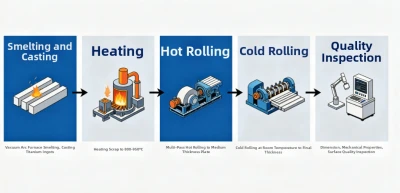
2. Complete Titanium Plate Manufacturing Process
The production of titanium plates, titanium sheets, and titanium strips requires specialized processing technology.
Unlike ordinary steel production lines, titanium manufacturing involves strict control from raw material preparation to final inspection.
2.1 Titanium Slab Preparation: Controlling Material Quality from the Beginning
The quality of titanium plate starts from the titanium ingot.
High-performance titanium plates usually use advanced melting technologies:
Vacuum Arc Remelting (VAR)
VAR technology improves:
Chemical uniformity
Alloy purity
Internal defect control
Electron Beam Melting (EB)
EB melting provides:
High purity titanium
Reduced inclusions
Excellent metallurgical quality
Before rolling, titanium ingots undergo:
Surface machining
Defect removal
Oxide layer elimination
Typically, several millimeters of surface material are removed to eliminate:
Cracks
Segregation defects
Surface contamination
Common Titanium Plate Standards
International titanium plate buyers usually require compliance with:
ASTM B265 Titanium and Titanium Alloy Strip, Sheet, and Plate
ASTM F136 Medical Grade Titanium Alloy
ASTM F67 Commercially Pure Titanium
AMS Aerospace Titanium Specifications
ISO Medical Titanium Standards
DIN Titanium Material Standards
Global Applications Driving Titanium Plate Demand
The increasing demand for lightweight and corrosion-resistant materials is accelerating titanium plate market growth.
Major application sectors include:
Aerospace Titanium Plate
Titanium alloys are widely used in:
Aircraft structures
Landing gear components
Engine parts
Spacecraft structures
because of their excellent:
Strength-to-weight ratio
Temperature resistance
Fatigue performance
Medical Grade Titanium Plate
Medical titanium is preferred for:
Orthopedic implants
Dental implants
Surgical instruments
because titanium provides:
Excellent biocompatibility
Corrosion resistance
Bone integration capability
Hydrogen Energy and Chemical Industry
With global energy transition accelerating, titanium plates are increasingly used in:
Hydrogen production equipment
Heat exchangers
Electrochemical systems
due to titanium's outstanding corrosion resistance.
2.2 Precision Heating Technology: Controlling Titanium Phase Transformation and Material Performance
Heating is one of the most critical stages in titanium plate manufacturing.
Unlike stainless steel or aluminum, titanium alloys have extremely sensitive phase transformation characteristics. The heating temperature directly determines:
Grain structure
Plastic deformation ability
Mechanical strength
Fatigue resistance
Corrosion performance
For this reason, advanced titanium plate manufacturers must precisely control heating temperature, heating speed, atmosphere protection, and holding time.
Titanium Plate Heating Temperature Control
Different titanium grades require different heating strategies.
Commercially Pure Titanium (CP Titanium)
Typical heating range:
850-950°C
Main objectives:
Improve plasticity
Reduce deformation resistance
Promote uniform grain structure
Grade 5 Titanium Alloy (Ti-6Al-4V)
Grade 5 titanium, also known as Ti-6Al-4V titanium alloy, is one of the most widely used titanium materials in aerospace and industrial applications.
Processing temperature is usually controlled near the:
Alpha + Beta phase region
Typical range:
920-980°C
The purpose is to achieve a balance between:
High strength
Good ductility
Excellent fatigue performance
Advanced Heating Methods for Titanium Plate Production
Modern titanium manufacturers commonly use:
Resistance Furnace Heating
Suitable for:
Small and medium production batches
Special alloy titanium plates
Customized titanium sheet production
Advantages:
Accurate temperature control
Flexible production scheduling
Induction Heating Technology
Used for:
Large-scale titanium production
High-efficiency manufacturing
Advantages:
Rapid heating speed
Reduced oxidation risk
Better energy efficiency
Modern induction systems can achieve heating rates exceeding:
50°C/min
Protective Atmosphere Technology
Because titanium has strong chemical activity at high temperatures, surface protection is essential.
Common protection methods include:
Argon Gas Protection
Prevents titanium from reacting with:
Oxygen
Nitrogen
Hydrogen
Protective Coating Technology
Special coatings are applied before heating to reduce:
Oxidation
Surface contamination
Alpha-case formation
This is particularly important for:
Aerospace titanium plates
Medical titanium sheets
High-performance titanium alloys
2.3 Hot Rolling Titanium Plate: The Core Forming Process
Hot rolling is the primary forming process for titanium plates.
During this stage, titanium slabs are transformed into semi-finished or finished plate products through controlled deformation.
The hot rolling process determines:
Plate thickness
Internal structure
Mechanical properties
Surface quality
Key Parameters of Hot Rolled Titanium Plate Production
1. Rolling Temperature Control
The initial rolling temperature must be carefully selected.
The objective is to ensure:
Sufficient plastic deformation
Dynamic recrystallization
Grain refinement
Improper temperature control may cause:
Coarse grains
Uneven microstructure
Reduced mechanical performance
2. Rolling Reduction Control
Titanium plate rolling follows the principle:
Large deformation first, precision control later
Typical reduction strategy:
First Rolling Pass
Reduction:
≤30%
Purpose:
Remove surface defects
Break casting structure
Improve internal uniformity
Intermediate Rolling Passes
Reduction:
15%-25%
Purpose:
Stable thickness reduction
Uniform deformation distribution
Final Rolling Stage
Small reduction:
≤10%
Purpose:
Improve dimensional accuracy
Optimize plate flatness
3. Advanced Thickness Control Technology
Modern titanium plate production lines use:
Automatic Gauge Control (AGC)
AGC systems provide:
Real-time thickness monitoring
Automatic rolling adjustment
Improved dimensional accuracy
High-quality titanium plates can achieve thickness tolerance:
±0.05mm
depending on product specifications and standards.
2.4 Warm Rolling Titanium Plate Technology: A Bridge Between Hot and Cold Processing
Warm rolling has become an increasingly important technology for producing